Posts

The Great Barrier Reef

Image
Coral reefs are amazingly diverse underwater habitats, home to turtles, dolphins and anemones and also dozens of different species of fish.  The Great Barrier Reef on Australia's north-east coast is a place of exceptional diversity and elegance. This comprises the world's largest collection of coral reefs, with 400 coral forms, 1,500 fish species, and 4,000 mollusc species. It also has great scientific interest, such as the habitat of animals like the dugong and the large green turtle, which are threatened with extinction. As the levels of carbon dioxide climb, water acidity is also rising to a degree not previously experienced by corals. Scientists have been looking for hot resistance spots, places where coral has already evolved to extreme heat and acidity such as volcanic vents and deep springs where carbon dioxide flows spontaneously through the sea floor.  Coral are capable of recovering, but not at the same pace as human activities are killing it. Consequently,...

Crabs

Image
Did you known that species like hermit crabs and horse crabs are not even crabs? If your answer is no to this question, be pleased to hear that neither did I, Hahahah.  Crabs are infraorder Brachyura decapod crustaceans that normally have a very small projection abdomen that is generally completely concealed under the thorax. They live in all the oceans of the world, in fresh water, and on land, are usually covered with a thick exoskeleton and have a pair of pinchers. Crabs are found in all oceans around the world whereas many crabs live in fresh water and on land, particularly in tropical regions. The size of crabs ranges from the pea crab, a few millimetres large, to the Japanese spider crab, up to 4 metres long. When I am at home I love seeing these beautiful creatures going about their lives on the mangroves and all over the beach.  Author: Brenda Moita 

The Green sea turtle

Image
The green sea turtle (Chelonia mydas) of the Cheloniidae family is a genus of large sea turtle. It is the only species within the Chelonia genus. Its range stretches all over the world across tropical and subtropical seas, with two distinct populations in the Atlantic and Pacific Oceans, but is also present in the Indian Ocean.  Adult green sea turtles prefer to live near seaside grass beds, mangroves and coral reefs while younger ones live further away from shore. Green sea turtles are one of the largest turtle species in the world, weighing about 65-130 kg and ranging between 1-1.2 m in length. Animals have a thick shell of tear-drop shape, called a' carapace,' covering most of their body except for their head and four flippers. Their carapace can contain shades of various colours, including dark brown, green, olive, yellow, and black.  Chelonia mydas  is classified by IUCN and CITES as endangered and is protected from exploitation in most countries. Collecti...

Dolphins

Image
Dolphins are mammalian animals which live in an aquatic environment and can be found in almost all marine environments. These creatures are incredibly intelligent and are able to communicate using language (which takes the form of the beautiful sounds they emit). Being under water with dolphins in their natural habitat is a wonderful experience. I love dolphins and I always get excited whenever I spot them.  Author: Brenda Moita 

Mufete

Image
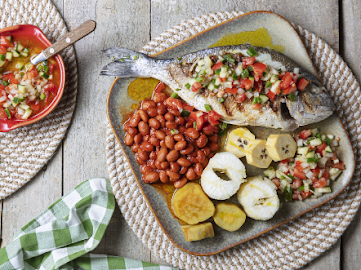
Mufete  This article is from a series of post on the topic of "What can the sea give us?".  Mufete is a dish of Angolan origin, more specifically, yes you guessed it, Luanda island. It is composed of grilled fish, banana bread, manioca, sweet potato and is accompanied palm oil bean. All those ingredients are from the island's natural resources and are therefore ethical and nonetheless incredibly delicious. Mufete is by the way one of my favourites dishes of the Angolan cuisine.  Author: Brenda Moita 

Shoaling and schooling

Image
In biological terms  every group of fish which remains together for practical reasons is shoaling, and if the group swims in a coordinated manner in the same direction, they're schooling.  Evolutionary biologists suggest that some fish have evolved to swim in schools in order to protect themselves from predators, to strengthen their foraging and to swim faster. Different to shoaling, where fish only swim together loosely manner, schooling includes coordinated postures and a movement which is synchronised.  Author: Brenda Moita 

Mussulo's Fauna

Image
Mussulo's Fauna  Mussulo is an island (peninsula) on the southern coast of Luanda in Angola. Mussulo's fauna possess a immense biodiversity as a wide range of creatures have this island as their natural habitat. The mangroves forest in Mussulo provide the nests for several marine creatures such as leader back turtles, green turtles, the common dolphin, sharks, octopus, squid, jelly fish, green swordtail, tetra, etc. These animals migrate to other parts of the globe according to the season, their life and reproductive cycle. From my experience I have seem a variety of fish, birds, crabs which are yet to be reported and even pigs. I have no doubts that are many more animals living there.   Author: Brenda Moita 

Why should we go to the beach more often?

Image
I love going to the beach and for me it is quite difficult to find a reason no to go. Whenever I'm there I enjoy snorkelling with my siblings and finding crustaceans, fish, some fossils and when lucky, dolphins. In medical terms, someone should go to the beach because it is a very easy way to get vitamin D which is important to absorb calcium and promote bone growth.  Furthermore, several types of cancer have been associated with lack of vitamin D e.g. breast cancer, colon cancer, prostate cancer, etc. so getting that extra supply of vitD could be a way to prevent disease. However, one should also be careful about the time and amount of sun exposure they have since the UV light can cause cellular damage and result in skin cancer. Other benefits linked to going to the beach include making beautiful memories in a gorgeous place with our loved ones, enjoying a wonderful sunset, exploring the local fauna and flora and finally, being more relaxed, less tired and happie...

Genuine Environmentally Friendly Fishing

Image
Many people have given up on meat due to its impact on the environment. Although years ago being a pescatarian appeared to be a sustainable alternative, the damaging impact that industrial fishing has caused to several marine ecosystems has raised the awareness of individuals, research organisations and several environmental activist groups which resulted in the reduction in consumption of a marine based diet. As a consequence one could easily come to the conclusion that fishing is bad, should be banned and meat consumption should completely cease.  However, indigenous  people have a vary varied diet that includes the consumption of met and fish, and they hunt and fish without harming the ecosystem in which they live in. Natives from Mussulo for example, live in perfectly equilibrium with the environment while having a diet that includes meet and fish. Perhaps, this is the sort of life that someone  extremely concerned about the environment sho...

The Importance of Mangroves

Image
Mangroves are small trees which grow in coastal saline or brackish water. Having grown in a tropical peninsula by the sea I have developed a deep passion for mangroves not only for its beauty but more importantly because of its role in biodiversity. I love seeing colourful carbs growing up there, marine snakes, and all sorts of tropical fishes.  Considering the place were I am from there would be no hope for me but to love mangroves. These trees are just wonderful and perfect in every aspect. By the way this photograph was taken at Barra do Kwanza in Angola. Mangroves are evergreen forests found extensively in estuarine regions where the mud flats are wide and gently sloping. In addition to estuaries, they also live in intertidal regions of shallow bays and creeks where the environment is favourable to the growth of mangroves. Mangroves are a complete ecosystem, a conglomeration of many species of flora and fauna  in the area and their interactions with each ...

Lemon Shark

Image
Lemon Shark  The lemon shark ( Negaprion brevirostris ) is a shark species of the Carcharhinidae family. Lemon sharks can grow to lengths of 3.4 metres. They are often found in subtropical shallow waters, and are known to inhabit and return for breeding to specific nursery sites.  In English they are called lemon sharks due to the yellow-brown colour of their skin (well they just look grey to me but I might be colour blind , who knows?!) which serves a means of camouflage with the sand. In order to hunt, they swim quite rapidly towards the prey, stopping abruptly before making contact, g rabbing the victim closely around his head and repeatedly turning it until bits of skin can be ripped off (savage!).  Author: Brenda Moita 

Nurse shark

Image
Nurse Shark   The Ginglymostoma cirratum  a.k.a the nurse shark is an elasmobranch species within the Ginglymostomatidae family. The nurse shark's conservation status is evaluated internationally as data deficient in the IUCN Threatened Species List. In the warm, shallow waters of the western Atlantic and eastern Pacific oceans you will find them. P.S. you might be able to find me as well. They break and eat shellfish and even coral with their strong jaws, but tend to dine on fish, shrimp, and squid. These are grey-brown marine creatures have characteristic tail fins which can have a total length of up to one-fourth. Nurses are smooth to the touch contrary to most other sharks.They are really cool, just don't try to pose with them for likes on Instagram, it upsets them and they might bite you like the that model.  Author: Brenda Moita 

Southern stingrays

Image
Southern stingrays  The sharks and skates are related to the southern stingrays. This stingray belongs to the Dasyatidae Family which includes 70 stingray species. Also nine other species, including the red stingray and roughtail stingray, are in the same genus. Southern rays can be found in the west Atlantic Ocean, Caribbean and Gulf of Mexico's tropical and subtropical seas, down the coast of southeastern Brazil. They make their home up to a depth of 180 feet in shallow coastal waters, and favour lagoon or coral reef environments where sandy bottoms and seagrass beds are located.  Author: Brenda Moita 

Spotted eagle ray

Image
Spotted eagle ray  The spotted eagle ray ( Aetobatus narinari ) is an eagle ray from a family of cartilaginous fish, Myliobatidae. Spotted eagle rays enjoy swimming in seas at a temperature of 24 to 27 ° C, and are more active in high tides. They are timid creatures who usually avoid humans, but they were seen jumping on boats and falling on people from the sea. Searching for their food, they dig their snouts into the sand on the seabeds. Groups of them consist of about 6 participants swimming at exactly the same speed in the same direction. Author: Brenda Moita 

Blue tang

Image
Blue tang  Famous for Finding Dory, this super star took the spot of Nemo and grabbed all the attention to herself, what a Narcissist!  The blue tang ( Paracanthurus hepatus ) is a genus of Surgeonfish from Indo-Pacific. It is the only member of the genus Paracanthurus, and a very common fish in marine aquariums all over the world. One can find the regal blue tang throughout the Indo-Pacific. The blue tang is seen in the coasts of Australia's Great Barrier Reef, the Philippines, Thailand, Japan, New Caledonia, Fiji, East Africa, and Sri Lanka.  The aim of both movies was to make people aware of the damaging effects to the ocean and its creatures that keeping fish as pets have. However, it just got the wrong effect on the public and sales for both the clownfish and the blue tang skyrocketed  after the films were released.  Author: Brenda Moita 

Jellyfish

Image
Jellyfish  Jellyfish live mainly in the seas, although I've seen them swimming in the river Tejo in Lisbon several times. They aren't technically fish, they are suprise, suprise...PLANKTON! Yeah, sorry. Such creatures either float in water or possess such restricted swimming forces that their horizontal motions are guided by currents. Some plankton are single-celled, small species while others are enormous. Jellyfish, with tentacles up to 100 feet long, can range in size from less than an inch to nearly 7 feet long. Jellyfish also belong to the phylum Cnidaria, (from the Greek word for "stinging nettle") and the class Scyphozoa (from the Greek word for "cup," referring to the body shape of the jellyfish). Both cnidarians are surrounded by tentacles and have a mouth in the middle of their bodies. Cnidarian relatives of the jellyfish include corals, sea anemones and the man-o'-war from Portugal. Jellyfish are approximately 98% water.    Autho...

Humpback whale

Image
The Humpback whale  The humpback whale ( Megaptera novaeangliae ) is a baleen-whale species. One of the larger rorqual species, adults range 12–16 metres in length and weigh between 25–30 metric tonnes. The body shape of the humpback is unique, with long pectoral fins and a knobbly nose. It is known for breaching and other signature surface activities that make this common with whale watchers. Humpback whales are present in rivers and seas around the world and usually migrate up to 25,000 km each year (just like myself when I backpacking in the summer). These creatures feed in polar waters and migrate to tropical or subtropical waters so they can mate and give birth. Their diet mainly consists of krill and small fish. Humpbacks have a diverse feeding system repertoire including the bubble net technique. Author: Brenda Moita 

Seagrass

Image
Seagrass  Seagrass is a wonder-plant that lives along our shore in sandy, flooded areas. It is important to our sea's safety, and can help address environmental issues. Seagrass traps carbon up to 35 times faster than tropical rainforests, and although it occupies just 0.2% of the seabed, it consumes 10% of the ocean's carbon every year, making it an important resource in the fight against climate change. Seagrass is essential to marine life which depends on food and shelter meadows.Seagrass is an important nursery for endangered species including seahorses and many of the fish that we eat, including cod, plaice and pollock.

Copperband Butterflyfish

Image
Copperband Butterflyfish  The Copperband Butterflyfish ( Chelmon rostratus)  is a very notable species, with its elongated snout. It is relatively thin and measures approximately 20 cm. Yet with a sleek form and fluid swimming motions (this wonderful marine creature moves like a bailarina dancing at the sound of the Four Seasons of Vivaldi), it is very attractively coloured and can be found in reefs of the Indian and Pacific Ocean. 

Moorish idol

Image
Moorish idol Did you know that Moorish idol have this name because of the Moors of Africa who believed that this beautiful fish could bring happiness. This fish are like my relatives from another ocean (Hahahah).  The Moorish Idol (Zanclus cornutus) is a species of marine fish, the only known example of the Zanclidae family. The Moorish idol, a typical inhabitant of tropical to subtropical reefs and lagoons, is noteworthy for its wide range throughout the Indo-Pacific.